
157

$

One-time enrollment · 12-month access

Enroll NowGroup pricing available →
THIS COURSE INCLUDES
  • 15 lessons · 1.5 hours of video
  • Downloadable PDF & Excel materials
  • Industry trends and future outlook
  • Review questions in each module
  • Final exam
  • Certificate of completion (1.50 CPE)
← Back to Courses & Career Tracks

Comprehensive Introduction to the Electric Industry: How the Power Business Really Works

A practical, in-depth introduction to the electric industry — how power is produced and delivered, how utilities and co-ops are structured and regulated, how electric rates are developed, who does the work, and where the industry is headed.

★★★★★  5.0
1.5

CPE Hours

|  Self-Paced Video
|  Basic Level
|  NASBA Registered
▶ Watch Free Course Preview

Whether you're new to the electric industry or moving into a finance, accounting, or operations role, this course gives you the big picture — how the electric system works from power plant to customer meter, how utilities and cooperatives are structured and regulated, and how the costs of running an electric system flow into customer rates.

You'll learn what the major job functions are across an electric utility, why regulatory oversight matters, and how rate design connects to the day-to-day accounting and financial management of the organization. The course wraps up with a look at the trends shaping the industry — from distributed energy resources to grid modernization — and what the electric business of the future may look like.

This is the recommended first course for anyone entering the utility industry, and it anchors both the New Electric Utility Professional and New Electric Cooperative Professional career tracks.

The Foundation Every Utility Professional Needs

About This Course

Who This Course Is For

  • New utility and co-op accounting, finance, and operations staff
  • Professionals transitioning into the electric industry from other sectors
  • Board and council members seeking a foundation in how utilities work
  • Engineers, IT, and field staff who work alongside finance teams
  • Auditors and consultants serving utilities and cooperatives
  • HR and training directors building new employee onboarding programs
Your Instructor

Taught by a Nationally Recognized Utility Accounting Expert

Russ Hissom, CPA
Principal, UtilityEducation.com · 35+ Years of Industry Experience
Russ Hissom is a national utility accounting and rate expert with 35+ years of hands-on experience helping electric cooperatives and utilities improve accounting processes, strengthen financial performance, and design fair, sustainable rates. He has provided expert witness testimony before FERC, state commissions, and in arbitration proceedings — and has trained 1,000+ utility and cooperative finance professionals nationwide.
Learning Objectives

This Course Will Provide You With the Knowledge To

✓

Explain how electricity is produced, transmitted, and delivered to homes and businesses
✓
Describe the regulatory environments that utilities and cooperatives operate in
✓
List current trends shaping the electric industry and describe what the utility of the future may look like
✓
Identify what people do in a utility or co-op and the impact each role has on the organization
✓
Apply at a high level how electric rates are developed and how customers pay for electricity
✓
Know the organizational layers in an electric co-op and utility
The Learning Experience

How You'll Learn

✓
Short Lessons, Not Long Lectures - Focused video lessons you can fit around your workday.
✓
Interactive Videos - Questions, activities and interactive content inside each video keep you engaged.
✓
Hands-On Practice - Exercises let you test your judgment and reinforce key points.
✓
Job-Ready Toolkits - Downloadable tools and guides for future reference or on the job.
✓
Practical Applications - Apply concepts to realistic situations.
✓
Built-In Reinforcement - Review questions throughout the course support retention of the material.
Student Feedback

What Our Students Say

"Very good overview of the introduction to the electricity business. I just recently started a job with a utility and am taking some courses to learn as much as possible. Will definitely be taking another course!"
— Jennifer
"This was an incredible overview! I cannot wait to share this with others. I LOVED how you explained things. You have great speaking and explanation skills."
— Nicole
"I came looking for an introduction to utilities course and I'm glad I took this one. Russ explained everything really well. I will be taking more courses!"
— Kritant
Course Curriculum

What You'll Learn

Course Accreditation

Course #
B-1
Area of Study
Business Management & Organization
Delivery
QAS Self Study
Prerequisites
None
Last Reviewed
6/29/26
Passing Grade
70%
Adv. Preparation
None
Program Level
Basic
1.5
NASBA CPE Credits

Course materials are provided for informational and educational purposes only. They do not constitute legal, accounting, or professional advice. Users should consult their own qualified legal, accounting, or other professional advisors regarding their specific circumstances.

Welcome to the Electricity Business

Course orientation, learning objectives, downloadable materials, and course roadmap. | 0.1 Electricity Powers Everything | 0.2 Course Learning Objectives | 0.3 Here are your course materials! | 0.4 Course Roadmap

Making and Delivering Electricity

Trace electricity from generation to the customer meter and understand who regulates the industry at the federal and state level. | 1.1 Making and Delivering Electricity

Who Works in an Electric Utility?

Explore the roles and functions across a utility or cooperative organization and understand the workforce challenges facing the industry. | 2.1 Who Works in an Electric Co-op or Utility? | 2.1 Flipcard Exercise — Reveal the Definitions

Setting Electric Rates

Understand how electric rates are developed, how regulatory oversight shapes pricing, and the principles behind cost recovery. | 3.1 How are Electric Rates Developed? | 3.2 Review Questions — 1

Current and Long-Term Industry Trends

Explore the forces reshaping the electric industry — from electrification and distributed energy resources to grid modernization and workforce change. | 4.1 Current and Long-Term Industry Trends | 4.2 Review Questions — 2

Course Wrap-Up & Final Exam

Review key takeaways, complete the scenario exercise, and pass the final exam. | 5.1 Course Wrap-up and Key Points | 5.2 Exercise — What Answer Fits the Scenario? | 5.3 Course Evaluation | 5.4 Final Exam | 5.5 Course Conclusion and Next Steps
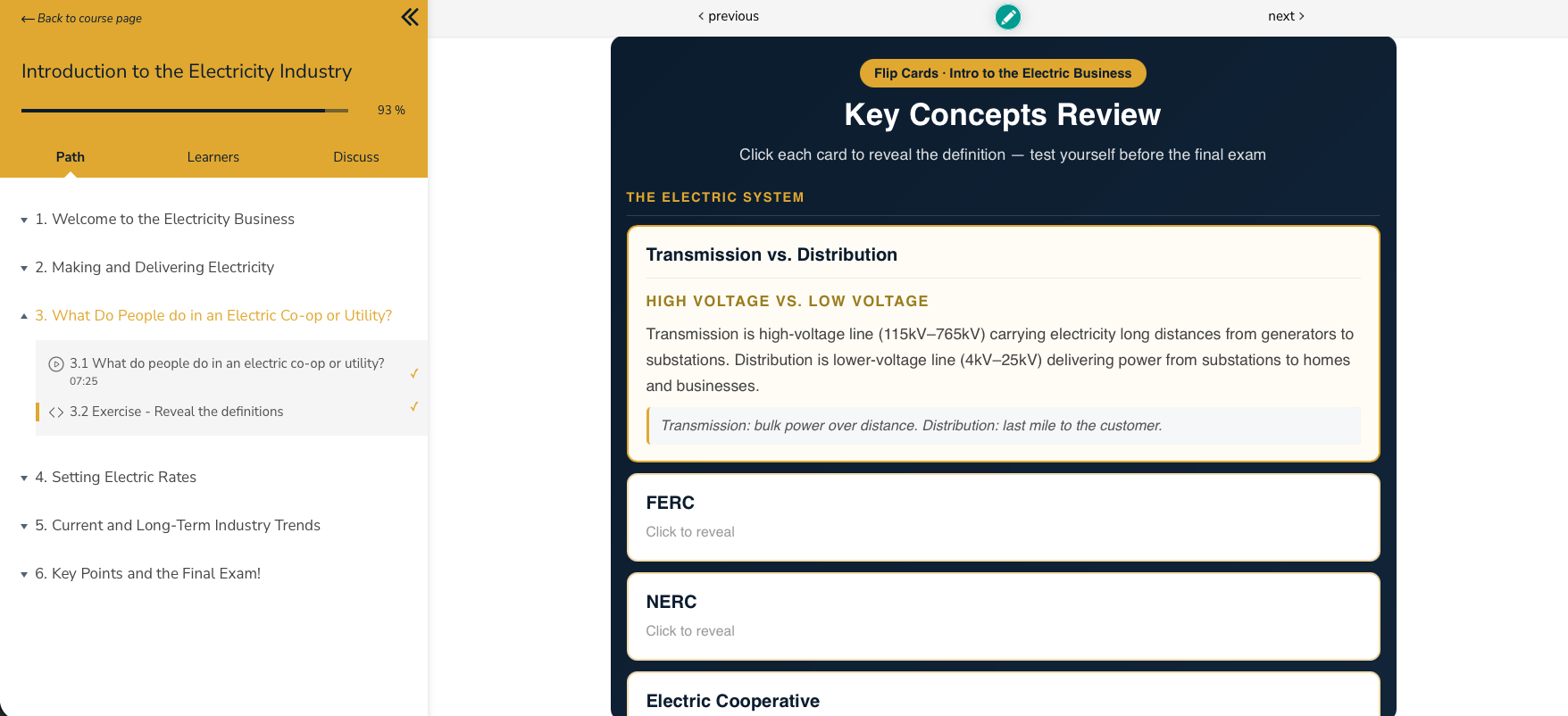
Inside the Course

See the Course in Action

Comprehensive Introduction to the Electric Industry: How the Power Business Really Works
Common Questions

Questions You May Have

What is included and how long do I have access?
All video lessons and course downloads are included. Course access is for 12 months from the date of purchase. Materials are available in PDF and Excel formats.
Are courses eligible for NASBA CPE credits?
Yes. This course is approved for 1.50 CPE credits through NASBA. Upon passing the final exam (70% or better), you'll receive a Certificate of Completion that meets NASBA documentation standards.
What if I have more questions?
We welcome your questions anytime. Emailruss.hissom@utilityeducation.comor call 608-628-4020.
Do I need prior utility experience?
No. This course assumes no prior knowledge of the electric industry. It's designed specifically for people who are new to utilities, cooperatives, or the energy sector.
Is this relevant outside of electric utilities?
The course focuses on electric utilities and cooperatives, but much of the regulatory, financial, and organizational content is applicable to gas, water, and other regulated utilities as well.
Is this a good fit for board or city council members?
Yes. This is the first course in the Board Member Career Track. It gives board and council members the industry context needed to ask better questions and make more informed governance decisions.

Not Sure Where to Start?

Enroll Now — >Watch Free Course Preview
© Utility Accounting & Rates Specialists, LLC. All rights reserved.