
$
One-time enrollment · 12-month access
Enroll NowGroup pricing available →Gain the skills to read, interpret, and analyze electric utility and co-op financial statements with confidence. Whether you work in finance, operations, or governance, this course gives you the tools to ask better questions and make better decisions.
CPE Hours
Electric utility and cooperative financial statements are packed with critical information — but only if you know how to read them. This course breaks down each financial statement, explains what it tells you about the organization's health, and gives you practical tools to analyze and interpret the numbers.
From the Statement of Net Position to the Notes to the Financial Statements and MD&A, you'll gain the financial literacy needed to engage effectively with auditors, finance teams, and board members.

Identify the four basic financial statements and explain the purpose of each
Course materials are provided for informational and educational purposes only. They do not constitute legal, accounting, or professional advice. Users should consult their own qualified legal, accounting, or other professional advisors regarding their specific circumstances.
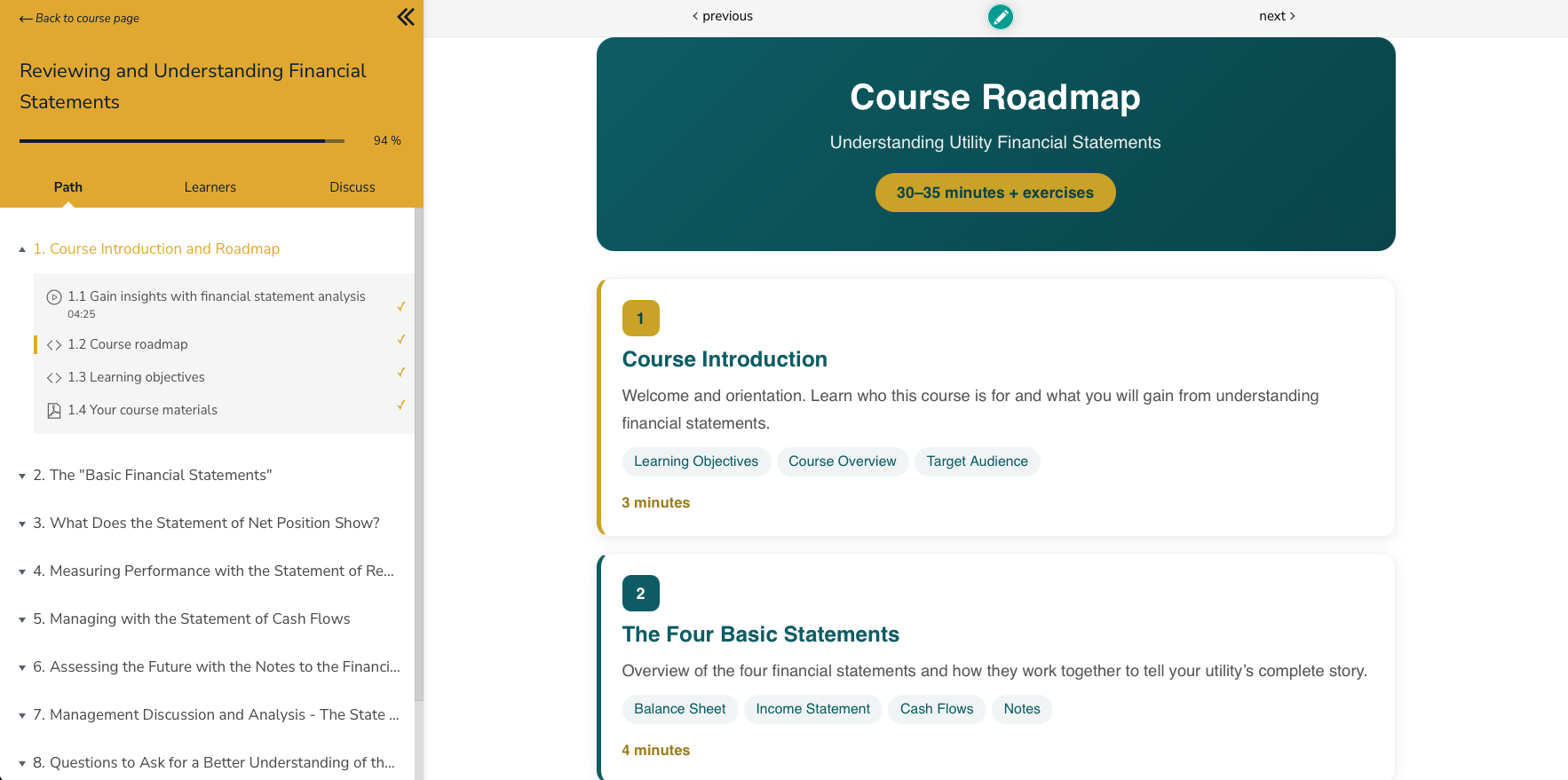
Overview of why financial statement analysis matters, the course roadmap, and learning objectives. | 1.1 – Gain Better Insights with Financial Statement Analysis | 1.2 – Course Roadmap | 1.3 – Course Learning Objectives
Introduces the four core financial statements and walks through real utility and co-op examples side by side. | 2.1 – Learning the Basic Financial StatementsFree Preview | 2A – Walk Through of Utility and Co-op Financial Statements
Deep dive into the balance sheet — what the organization owns, owes, and its retained net position — including review questions. | 3.1 – Statement of Net Position: Our Business Retained Earnings | 3.2 – Review Questions 1
Covers the income statement equivalent — what drives the bottom line — with an interactive financial statement classification exercise. | 4.1 – Statement of Revenues, Expenses, and Changes in Net Position | 4.2 – Exercise: Classifying Financial Statement Items
Explains the three sections of the cash flow statement and how they reveal the organization's liquidity and financial flexibility. | 5.1 – Statement of Cash Flows: What Cash Do We Have to Provide Service?
The often-overlooked goldmine — how to navigate the Notes to find critical accounting policies, commitments, and disclosures. | 6.1 – Notes to the Financial Statements: The Nuggets for Understanding the Details
Covers the MD&A section — management's narrative on results, risks, and outlook — and a financial statement item classification exercise. | 7.1 – Management Discussion and Analysis | 7.2 – Where Does the Financial Statement Item Belong?
Equips you with the right questions to ask finance teams, auditors, and management — and review questions to reinforce the course content. | 8.1 – Questions to Ask for Better Understanding | 8.2 – Review Questions 2
Course summary, next steps, and the NASBA-compliant final exam. A passing score of 70% earns your 1.50 CPE certificate. | 9.1 – Course Summary and Next Steps | 9.2 – Course Evaluation | 9.3 – Final Exam | 9.4 – Course Completion and Next Steps!