
157

$

One-time enrollment · 12-month access

Enroll NowGroup pricing available →
THIS COURSE INCLUDES
  • 7 modules · self-paced video
  • Sample Cost Allocation Manual (populated example)
  • Cost Allocation Manual template (fill-in-the-blank)
  • Annual review checklist & industry resources
  • Final exam
  • Certificate of completion (1.5 CPE)
← Back to Courses & Career Tracks

Beyond the 3-Point: Advanced Cost Allocation Strategies

Advanced Methodology · Selection Frameworks · Implementation & Documentation

Go beyond the 3-point formula. Learn advanced cost allocation methodologies—activity-based costing, driver-based allocations, and hybrid approaches—plus the selection framework, and implementation roadmap, to make your cost allocation methods fair to internal departments and ratepayers.

★★★★★  5.0
1.5

CPE Hours

|  Self-Paced Video
|  Basic Level
|  NASBA Registered
▶ Watch Free Course Preview

Most utilities know the 3-point Massachusetts formula—but cost allocation doesn't stop there. Increasingly, regulators, auditors, and department managers expect more sophisticated methodologies that tie costs to their true drivers. This course takes you there.

You'll master a full toolkit of allocation methods—activity-based costing, driver-based allocations, and hybrid approaches—along with a structured framework for selecting the right method for each cost pool. The course walks through real-world case studies from small municipals to mid-size cooperatives, showing how methodology choices play out in practice.

Whether you're refreshing an outdated cost allocation manual, defending methodology choices to regulators, or managing a methodology transition, this course gives you the knowledge and documentation tools to do it right.

Advanced Methodologies for Fair Interdepartmental Cost Allocations

About This Course

Who This Course Is For

Who This Course Is For

  • Finance and accounting staff who already know the 3-point formula
  • Rate analysts selecting or defending allocation methods
  • Controllers and CFOs responsible for cost allocation policy
  • Managers overseeing Cost Allocation Manual development
  • Anyone implementing a methodology change at their utility
Your Instructor

Taught by a Nationally Recognized Utility Accounting Expert

Russ Hissom, CPA
Principal, UtilityEducation.com · 35+ Years of Industry Experience
Russ Hissom is a national utility accounting and rate expert with 35+ years of hands-on experience helping electric cooperatives and utilities improve accounting processes, strengthen financial performance, and design fair, sustainable rates. He has provided expert witness testimony before FERC, state commissions, and in arbitration proceedings — and has trained 1,000+ utility and cooperative finance professionals nationwide.
Learning Objectives

This Course Will Provide You With the Knowledge To

✓

Compare and contrast allocation methodologies beyond the 3-point formula—strengths, weaknesses, data requirements, and appropriate applications
✓
Select and justify specific cost drivers for common utility service functions using cost-causation principles
✓
Design and execute stakeholder engagement strategies to gain acceptance for methodology changes
✓
Apply a structured decision framework to select the most appropriate allocation method based on size, data availability, and regulatory environment
✓
Create a comprehensive Cost Allocation Manual that meets regulatory requirements and audit standards
✓
Apply concepts through real-world case studies spanning small municipals to mid-size cooperatives
The Learning Experience

How You'll Learn

✓
Short Lessons, Not Long Lectures - Focused video lessons you can fit around your workday.
✓
Interactive Videos - Questions, activities and interactive content inside each video keep you engaged.
✓
Hands-On Practice - Exercises let you test your judgment and reinforce key points.
✓
Job-Ready Toolkits - Downloadable tools and guides for future reference or on the job.
✓
Practical Applications - Apply concepts to realistic situations.
✓
Built-In Reinforcement - Review questions throughout the course support retention of the material.
Student Feedback

What Our Students Say

"Very good overview of the introduction to the electricity business. I just recently started a job with a utility and am taking some courses to learn as much as possible. Will definitely be taking another course!"
— Jennifer
"This was an incredible overview! I cannot wait to share this with others. I LOVED how you explained things. You have great speaking and explanation skills."
— Nicole
"I came looking for an introduction to utilities course and I'm glad I took this one. Russ explained everything really well. I will be taking more courses!"
— Kritant
Course Curriculum

What You'll Learn

Course Accreditation

Course #
AT-14
Area of Study
Accounting-Technical
Delivery
QAS Self Study
Prerequisites
None
Last Reviewed
6/13/26
Passing Grade
70%
Adv. Preparation
None
Program Level
Intermediate
1.5
NASBA CPE Credits

Course materials are provided for informational and educational purposes only. They do not constitute legal, accounting, or professional advice. Users should consult their own qualified legal, accounting, or other professional advisors regarding their specific circumstances.

Introduction & Course Overview

Orientation to the course, the cost-causation principle, and the cost allocation hierarchy. Covers the five learning objectives and what you'll leave with. | 1.1 Course Overview & Learning Objectives | 1.2 The Cost Allocation Hierarchy | 1.3 The Core Principle: Cost-Causation

Allocation Methods Deep Dive

A comprehensive survey of methodologies beyond the 3-point formula—activity-based costing, driver-based allocations, hybrid approaches, and weighted vs. simple averages. | 2.1 Taking a Deep Dive into Allocation Methods | 2.2 Activity-Based Costing (ABC) | 2.3 Driver-Based Allocations | 2.4 Hybrid Approaches & Weighted Averages

Selection Framework & Decision Criteria

A structured framework for choosing the right method. Covers the six decision criteria, regulatory considerations, documentation requirements, and the 7-step process for changing methodology. | 3.1 Choosing the Right Method | 3.2 Regulatory Considerations | 3.3 Documentation Requirements | 3.4 Changing Your Methodology

Real-World Case Studies

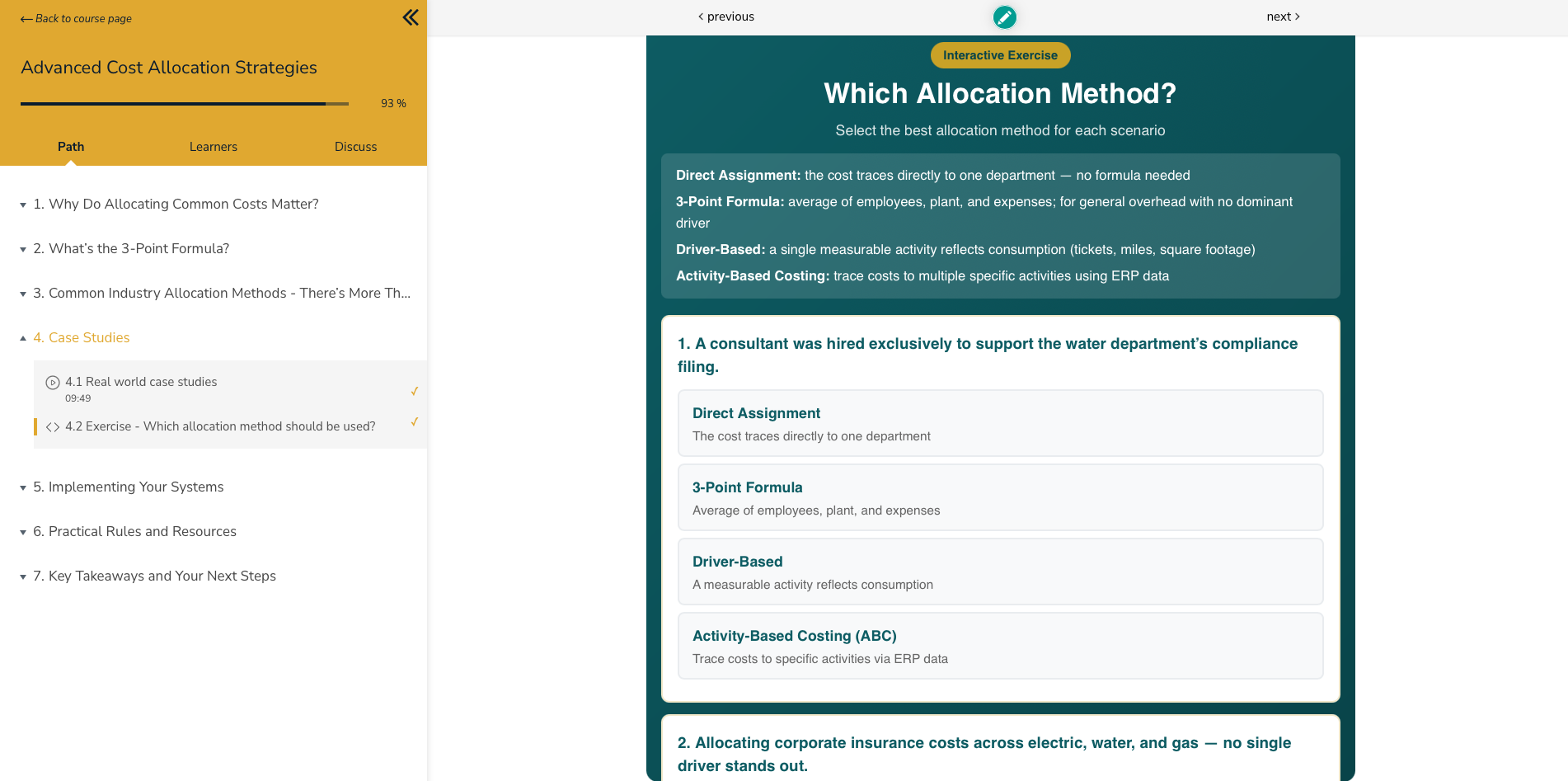
Two detailed case studies—a small municipal utility and a mid-size cooperative—showing how methodology choices play out when departments push back and regulators scrutinize allocations. | 4.1 Case Study: Small Municipal Utility | 4.2 Case Study: Mid-Size Cooperative

Implementation & Change Management

Building a Cost Allocation Manual, stakeholder engagement strategies, phased implementation, common pitfalls, and the annual review process. | 5.1 Building Your Cost Allocation Manual | 5.2 Stakeholder Engagement Strategies | 5.3 Phased Implementation & Common Pitfalls | 5.4 Annual Review & Continuous Improvement

Practical Tools & Resources

Your downloadable resource package—a fully populated sample Cost Allocation Manual and a fill-in-the-blank template—plus an annual review checklist and industry reference sources. | 6.1 Sample Cost Allocation Manual (Populated Example) | 6.2 Cost Allocation Manual Template | 6.3 Annual Review Checklist & Industry Resources

Course Wrap-Up & Final Exam

Synthesis of key principles, your 30-60-90 day action plan, and the final exam.  | 7.1 Five Essential Principles & Key Takeaways | 7.2 Your 30-60-90 Day Action Plan | 7.3 Course Evaluation | 7.4 Final Exam
Inside the Course

See the Course in Action

Beyond the 3-Point: Advanced Cost Allocation Strategies
Common Questions

Questions You May Have

What is included and how long do I have access?
All video lessons and course downloads are included, including a sample Cost Allocation Manual and a fill-in-the-blank CAM template. Course access is for 12 months from the date of purchase.
Can these methods be used for budgeting and rate studies?
Absolutely. The techniques are commonly used for internal budgeting, financial reporting, and as inputs to cost-of-service and rate analyses.
Are courses eligible for NASBA CPE credits?
Yes. This course is approved for 1.5 CPE credits through NASBA. Upon passing the final exam (70% or better), you'll receive a Certificate of Completion that meets NASBA documentation standards.
Do I need advanced accounting knowledge?
No. The course is designed to be practical and approachable, building from core concepts and walking through calculations step by step.
Does the course include examples I can adapt?
Yes. The course includes real-world examples and templates that can be customized to fit your organization's structure and support cost categories.
Will this work for both small and large utilities?
Yes. The methods are scalable and can be applied to organizations of different sizes and complexity levels.

Not Sure Where to Start?

Enroll Now — >Watch Free Course Preview
© Utility Accounting & Rates Specialists, LLC. All rights reserved.