The Three-Point Formula & Allocating Interdepartmental Costs | UtilityEducation.com
Rates & Cost of Service  ·  Basic

The Three-Point Formula & Allocating Interdepartmental Costs

Cost Allocation Theory · Industry Methods · Fair & Defensible Results

Learn the 3-point Massachusetts formula and other industry-standard methods for allocating support costs between departments—with the journal entries, calculation steps, and fairness framework to put it into practice at your utility or co-op.

★★★★★ 5.0
1.00 CPE Hour Self-Paced Video Basic Level NASBA Registered
Watch Free Lesson Preview
Module 3 — Common Industry Allocation Methods · Opens in course platform
$127
One-time enrollment  ·  12-month access
Enroll Now — $127
This Course Includes
  • 14 lessons · self-paced video
  • Downloadable PDF & Excel materials
  • 3-point formula calculation templates
  • Service level agreement example
  • NASBA-compliant final exam (5 questions)
  • Certificate of completion (1.00 CPE)
1.00
CPE Hour
5
Modules
14
Lessons
5.0
Average Rating
1,000+
Professionals Served
About This Course

Allocate Support Costs Fairly—and Defend Your Results

Every utility and co-op has support departments—IT, HR, finance, fleet—whose costs need to be allocated across the organization. How those costs are allocated affects departmental budgets, cost-of-service studies, and ultimately customer rates. This course gives you the framework to do it right.

You'll learn the fundamentals of cost allocation theory, the industry-standard 3-point Massachusetts formula, and how to calculate allocation rates step by step. The course also addresses the fairness questions that inevitably come up when departments push back—and gives you the tools to address them confidently.

Whether you're allocating IT costs across departments or preparing inputs for a rate study, this course gives you the practical skills and defensible methodology to get it done.

Who This Course Is For
  • Finance and accounting staff responsible for cost allocation
  • Rate analysts preparing cost-of-service studies
  • Controllers and CFOs overseeing interdepartmental billing
  • Department managers involved in budget discussions
  • Anyone preparing or reviewing joint IT service agreements
Your Instructor

Russ Hissom, CPA

RH
Russ Hissom, CPA
Principal, UtilityEducation.com  ·  30+ Years of Utility Accounting Experience

Russ Hissom, CPA is a principal of UtilityEducation.com, providing on-demand professional education in FERC, RUS, FASB, and GASB accounting, finance, and ratemaking for electric utilities and cooperatives. With over 30 years of hands-on industry experience, he brings real-world expertise to a modern learning platform trusted by more than 1,000 professionals.

Learning Objectives

What You'll Be Able to Do After This Course

Apply the fundamentals of cost allocation theory
Identify what departmental support cost types consist of
List industry-standard methods for allocating support costs
Calculate allocation rates for the 3-point Massachusetts formula cost allocation method
Detail discussion points for common questions about the "fair" allocation of interdepartmental costs
Prepare a service level agreement for joint information technology services
Apply detailed journal entries used to allocate internal costs
Detailed Curriculum

Inside the Course

Module 1 Welcome & Course Overview

Orientation to the course, learning objectives, and downloadable course materials.

  • Lesson Menu / Index
  • 1. Course Overview
  • 2. Course Learning Objectives
  • 3. Course Materials Download
Module 2 What's the 3-Point Formula?

Introduction to the 3-point Massachusetts formula—what it is, why it's the industry standard, and how it differs from simpler allocation approaches.

  • 4. The 3-Point Formula — Accounting Method for Interdepartmental Cost Allocations
Module 3 Common Industry Allocation Methods

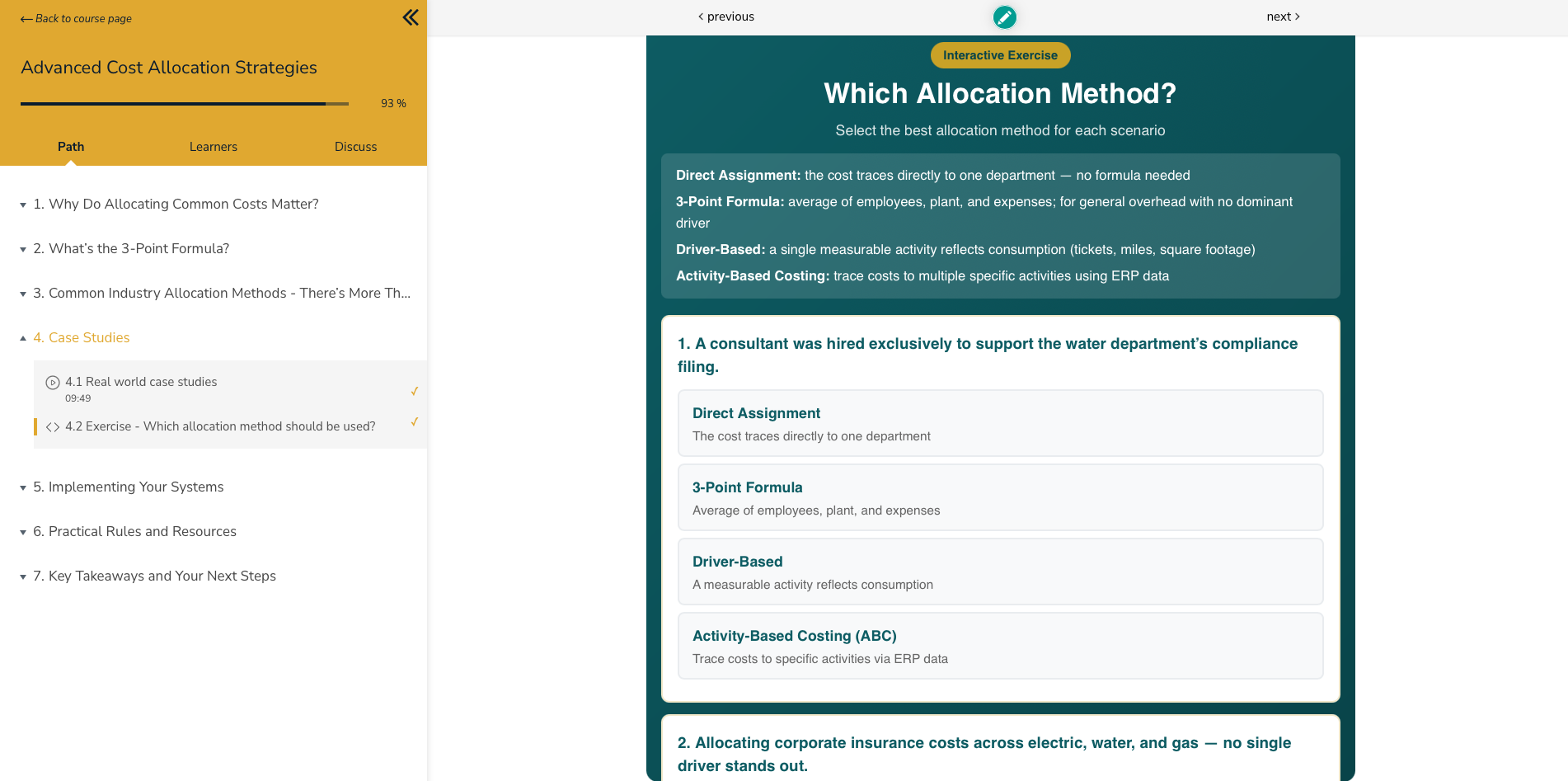
Survey the full range of industry allocation methods, work through the 3-point and Massachusetts formula step by step, and reinforce skills with review questions.

  • 5. Common Industry Allocation Methods Free Preview
  • Thought Break
  • 6. The 3-Point and Massachusetts Formula — Industry Standard Allocator
  • 7. Review Questions — Part 1
Module 4 Define Fairness

Address the fairness questions departments always ask—and build the talking points to answer them confidently.

  • 8. Addressing Departmental Concerns — Is It Fair?
  • 9. Review Questions — Part 2
Module 5 Course Wrap-Up & Final Exam

Apply what you've learned to your organization and pass the final exam to earn your 1.00 CPE certificate.

  • 10. Applying the 3-Point in Your Organization & Final Thoughts
  • 11. Course Evaluation
  • 12. Final Exam
Course Accreditation
NASBA QAS Self Study
Course #AT-14
Program LevelBasic
Area of StudyAccounting – Technical
DeliveryQAS Self Study
PrerequisitesNone
Adv. PreparationNone
Exam Questions5
Passing Grade70%
Last Reviewed8/1/24
1.00
NASBA CPE Credit
What Our Students Say

Trusted by Over 1,000 Utility Professionals

★★★★★

"Very good overview of the introduction to the electricity business. Will definitely be taking another course through UtilityEducation.com."

— Jennifer
★★★★★

"This was an incredible overview! I cannot wait to share this with others. I LOVED how you explained things. You have great speaking and explanation skills."

— Nicole
★★★★★

"Russ was great and explained everything really well — someone who has actually been in the industry. I will be taking more courses!"

— Kritant
★★★★★

"Good basic understanding of RUS and the chart of accounts. I came from outside the utility world and was quite lost. This class helps provide a solid foundation."

— Julie
★★★★★

"Great training for our Board members."

— Noah
★★★★★

"Was a quick, easy and great information!"

— Mary
Common Questions

Frequently Asked Questions

What is included and how long do I have access?
All video lessons and course downloads are included. Course access is for 12 months from the date of purchase. Materials are available in PDF and Excel formats.
Do I need advanced accounting knowledge?
No. The course is designed to be practical and approachable, building from core concepts and walking through calculations step by step.
Does the course include examples I can adapt?
Yes. The course includes real-world examples and templates that can be customized to fit your organization's structure and support cost categories.
Will this work for both small and large utilities?
Yes. The methods are scalable and can be applied to organizations of different sizes and complexity levels.
Can these methods be used for budgeting and rate studies?
Absolutely. The techniques are commonly used for internal budgeting, financial reporting, and as inputs to cost-of-service and rate analyses.
Are courses eligible for NASBA CPE credits?
Yes. This course is approved for 1.00 CPE credit through NASBA. Upon passing the final exam (70% or better), you'll receive a Certificate of Completion that meets NASBA documentation standards.
Where does the course content come from?
Content is drawn from industry best practices and the instructor's direct experience working with utilities and cooperatives across the United States and Canada.
What if I have more questions?
We welcome your questions anytime. Email russ.hissom@utilityeducation.com or call 608-628-4020.
Continue Your Development

Related Courses

Enroll Today

Capture Your Allocations

Join over 1,000 utility and co-op professionals building practical skills that improve cost accuracy and rate defensibility.

NASBA CPE Sponsor Logo

Utility Accounting and Rates Specialists, LLC is registered with the National Association of State Boards of Accountancy (NASBA) as a sponsor of continuing professional education on the National Registry of CPE Sponsors. State boards of accountancy have final authority on the acceptance of individual courses for CPE credit. Complaints regarding registered sponsors may be submitted to the National Registry of CPE Sponsors through its website: NASBAregistry.org.

Refund & Cancellation Policy

Requests for refunds must be made in writing within 30 days of purchasing the course. No refunds will be granted after the qualified assessment has been completed. For any concerns, please contact us at 608-628-4020 or at russ.hissom@utilityeducation.com.

Legal Note

Course materials are provided for informational and educational purposes only. They do not constitute legal, accounting, or professional advice. © 2026 Utility Accounting & Rates Specialists, LLC. All rights reserved.