
$
One-time enrollment · 12-month access
Enroll NowGroup pricing available →Learn how to consolidate continuing property records without changing general ledger balances, improve cost-of-service outcomes, and reduce the accounting burden of maintaining excessive CPR detail.
CPE Hours
Continuing property records are the foundation of utility plant accounting—but most utilities either have too many CPRs creating unnecessary maintenance burden, or too few leaving gaps that create problems at rate cases and audits. This course shows you how to build and maintain a CPR system that's right-sized for your utility.
You'll learn the four essential data elements every CPR must contain, how to apply the "shrink the units" methodology to consolidate records without losing cost or vintage accuracy, and four proven retirement accounting methods used by utility accountants across the country.
Applicable to both FERC and RUS regulated utilities, this course gives you practical strategies you can apply immediately to improve accuracy, reduce maintenance burden, and produce better support for rate cases and audits.

Identify the four essential data elements every continuing property record must contain and explain why each matters
Course materials are provided for informational and educational purposes only. They do not constitute legal, accounting, or professional advice. Users should consult their own qualified legal, accounting, or other professional advisors regarding their specific circumstances.
Welcome to the course — what CPRs are, why they matter, and what you'll be able to do when you're done. | 1.1 Welcome & Course Overview | 1.2 Learning Objectives | 1.3 Course Materials Download
What CPRs are, what they are not, the four essential data elements, and how CPRs connect to the general ledger, depreciation studies, and rate cases. | 2.1 CPR Fundamentals | 2.2 The Four Essential Elements | 2.3 CPRs and the General Ledger- Review Questions
Why engineering, construction, and accounting all need different things from asset data — and how to find the collaboration sweet spot that serves everyone without creating redundant systems. | 3.1 Engineering Perspective | 3.2 Construction Perspective | 3.3 Accounting Perspective | 3.4 Compatible Units vs. CPRs- Review Questions
The "shrink the units" methodology — how to consolidate thousands of CPRs into manageable groups while preserving cost and vintage accuracy. Includes GIS integration and GL reconciliation. | 4.1 The CPR Overload Problem | 4.2 Shrink the Units | 4.3 GIS and CPR Integration | 4.4 GL Reconciliation- Review Questions · Classification Exercise
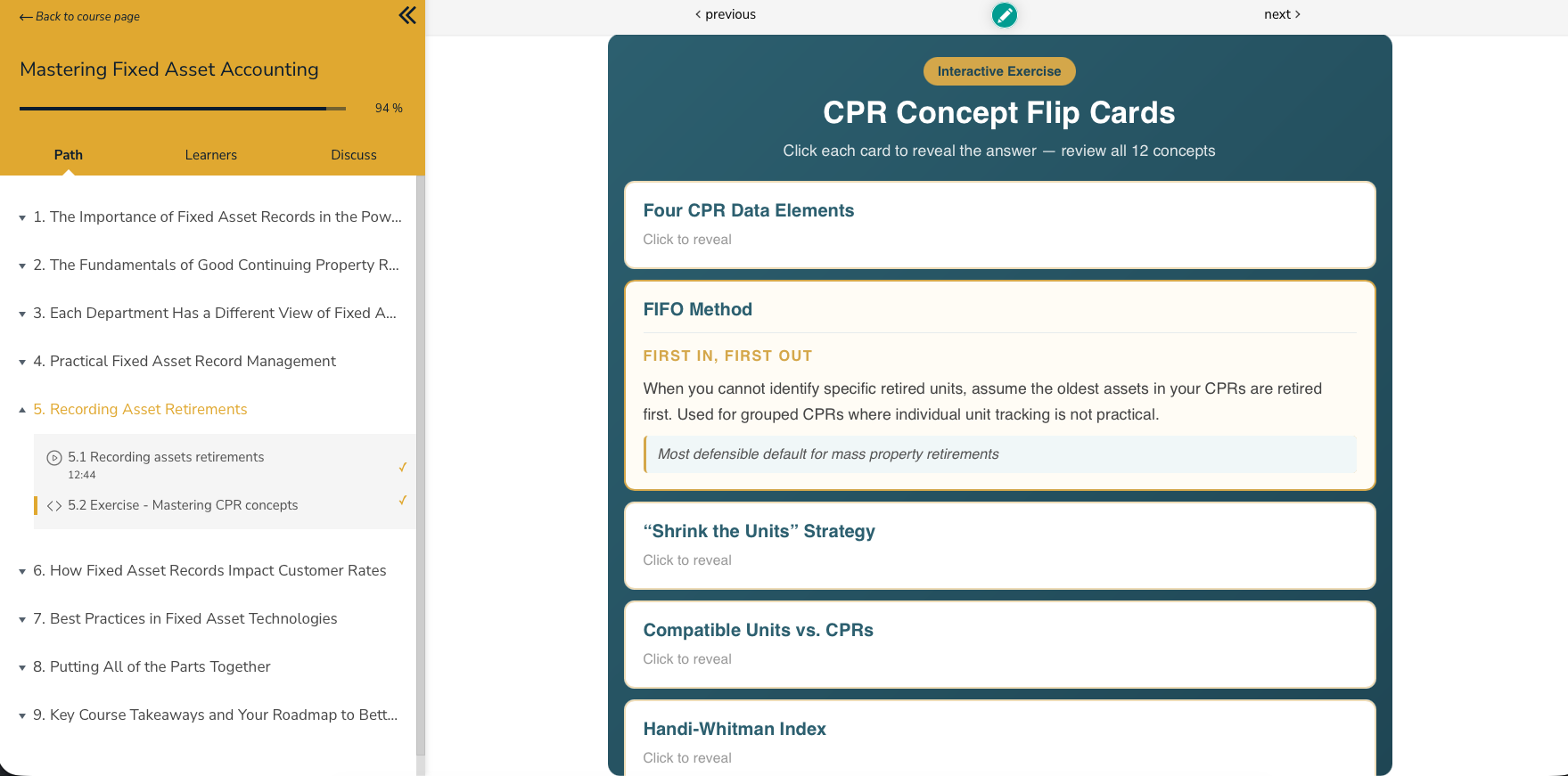
Four proven retirement methods — direct CPR lookup, FIFO, Handi-Whitman index, and estimation — when to use each, and how to document your approach for auditors and regulators. | 5.1 Why Retirement Accounting Matters | 5.2 Direct CPR Lookup | 5.3 FIFO Method | 5.4 Handi-Whitman Index | 5.5 Estimation- Review Questions · Retirement Method Exercise
How CPR historical cost and vintage data drives cost allocation and rate cases — and what regulators require in your CPR documentation. | 6.1 How CPRs Drive Customer Rates | 6.2 Cost Allocation Basics | 6.3 Rate Case Documentation Requirements- Review Questions
Evaluating CPR technology from spreadsheets to cloud systems, integration with work order and GL systems, annual CPR audits, and common pitfalls to avoid. | 7.1 Technology Options | 7.2 System Integration | 7.3 Annual CPR Audit- Review Questions
The complete CPR lifecycle — from construction closeout through retirement — and the CPR "sweet spot" that balances detail with maintainability. | 8.1 The Complete CPR Lifecycle | 8.2 Finding the Sweet Spot | 8.3 Comprehensive Exercise
Six key takeaways, next steps for your utility, and the final exam. | 9.1 Six Key Takeaways | 9.2 Course Evaluation- Final Exam